


Dive Into the New Age of Accelerated Analytics
PRODUCTS
Oscilloscopes
Oscilloscope Probes
Battery Simulators & Analyzers
Device Current Waveform Analyzers
BenchVue Software Applications
LCR Meters
Digital Multimeters
Function / Arbitrary Waveform Generators
Data Acquisition & Switching Systems
Counters / Timers
Power Supplies
Electronic Loads
Network Analyzers
Signal Analyzers
Signal Generators
RF & Microwave Handheld Analyzers
Handheld Test Instrument
Microwave Test Accessories
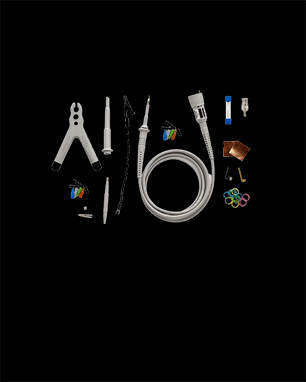
Passive Probes
Keysight offers a broad range of passive probes with various attenuation ratios and input impedance specifications to optimize the dynamic range and loading considerations of your oscilloscope ground-reference measurements. These passive probes are compatible with most Keysight oscilloscopes that have either standard BNC inputs or AutoProbe1/BNC input connections.


-
Input impedance when terminated into oscilloscopes with 1-MΩ input terminations. For higher-bandwidth Infiniium oscilloscopes with 50-Ω input terminations only, the E2697A high impedance adapter can be purchased (includes 10073D 500-MHz passive probe) to provide a 1-MΩ input termination.
-
For proper probe compensation (flatness), the oscilloscope’s input capacitance must be within the specified compensation range of the probe.
-
Capacitance at the probe tip of 1:1 probes is the specified probe capacitance plus the capacitance of the oscilloscope when terminated into 1-MΩ.
-
Input impedance when terminated into oscilloscopes with 50-Ω input terminations. These probes are not compatible with Keysight’s InfiniiVision 1000 and 2000 X-Series oscilloscopes.
PRODUCTS
Oscilloscopes
Oscilloscope Probes
Battery Simulators & Analyzers
Device Current Waveform Analyzers
BenchVue Software Applications
LCR Meters
Digital Multimeters
Function / Arbitrary Waveform Generators
Data Acquisition & Switching Systems
Counters / Timers
Power Supplies
Electronic Loads
Network Analyzers
Signal Analyzers
Signal Generators
RF & Microwave Handheld Analyzers
Handheld Test Instrument
Microwave Test Accessories

Optically Isolated Differential Probes
Galvanically isolated voltage probes separate the device under test (DUT) from the oscilloscope and earth ground, enabling safer and more accurate measurements. These types of probes have a high common-mode rejection ratio (CMRR), which is essential for capturing small signals in the presence of large common-mode voltages at floating nodes. Keysight's isolated probes have a CMRR up to 10 billion times higher than standard differential voltage probes referenced to earth ground. The CMRRs of Keysight's isolated probes are driven by the attached probe tip.
-
Probe tip dependent. View the compatible tips on the probe model web pages.

PRODUCTS
Oscilloscopes
Oscilloscope Probes
Battery Simulators & Analyzers
Device Current Waveform Analyzers
BenchVue Software Applications
LCR Meters
Digital Multimeters
Function / Arbitrary Waveform Generators
Data Acquisition & Switching Systems
Counters / Timers
Power Supplies
Electronic Loads
Network Analyzers
Signal Analyzers
Signal Generators
RF & Microwave Handheld Analyzers
Handheld Test Instrument
Microwave Test Accessories

Differential Active Probes
Probing high-speed differential buses typically requires differential active probes. Keysight offers a broad range of differential active probing solutions for your unique measurement requirements based on bandwidth, dynamic measurement range, and probe loading.
-
Auto-selected based on V/division setting.
-
Requires differential probe head sold separately.
-
Not compatible with InfiniiVision X-Series oscilloscopes, but is compatible with the Infiniium UXR (1 mm & 1.85 mm models) with the cascaded use of the N5442A and N2852A adapters


-
The RCRC architecture is best suited for low source-impedance signals, while the RC architecture, with its lower loading effect, is especially suitable for measuring signals that switch to low-power modes.
-
The listed probe noise refers to the most common measurement settings. Actual probe noise may vary due to multiple factors, including attenuation ratio, probe tip, and probe mode.
-
Capable of measuring differential, single-ended, and common-mode signals.
-
Automatically selected based on the volts/div (volts per division) setting in all modes.